

If you’ve ever searched for someone to help with UI UX design, you’ve probably run into a wall of confusing job titles. UI designer, UX designer, product designer, interaction designer… they all sound like they might mean the same thing, but they really don’t.
Here’s where a lot of buyers go wrong: they hire for the narrow version of the job when they actually need the full picture. They brief for polished screens when what they’re really missing is strategic thinking, user research, and a designer who can connect their business goals to real outcomes.
A digital product designer isn’t just someone who makes interfaces look good. The role spans five distinct skill areas, from research and interaction design through to product strategy, and the best practitioners work end-to-end across a project, not just at the “make it pretty” stage.
In this post, we’ll break down what digital product design actually covers, why the distinction matters for the work you commission, and how understanding the full scope of the role leads to better briefs and stronger results. Let’s start with the mix-up that causes the most damage.
The Mix-Up That Costs Projects
If you’ve ever Googled “UI UX design” or “UX designer” when you needed help with a digital product, you’re in good company. These labels get used interchangeably all the time, but the scope behind them is genuinely different, and commissioning the wrong one costs projects.
A useful analogy: hiring a UI designer when you need a product designer is a bit like asking a builder to draw up the architectural plans. The skillsets overlap, but the job is not the same. One executes; the other shapes what gets built and why.
The knock-on effect is predictable. A narrow label produces a narrow brief. A narrow brief produces a narrow solution. And when that solution underperforms, everyone quietly blames “the design” rather than the scoping decision that preceded it.
This mix-up tends to happen most with experienced buyers, founders, heads of product, marketing directors, people who know their own domain extremely well but are newer to commissioning design work. It is not a knowledge gap about business; it is a terminology gap about what this particular discipline actually covers.
The good news is that naming this confusion early, rather than quietly papering over it mid-project, is itself a valuable thing a senior product designer brings to an engagement. If you want a sense of the skills and principles that framing draws on, that is worth a look before we get into the detail.
What Product Design Actually Spans
So what does the role actually cover? A digital product designer works end-to-end, from the first “what are we even solving?” conversation through to implementation. Not just the visual layer bolted on at the end of someone else’s thinking.
As introduced above, the role spans five core competency areas, and UI sits inside just one of them.
A useful way to think about it: the product designer is the person whose job it is to keep the user’s perspective in the room when business decisions get made, not just when screens get drawn.
This is not a debate about job titles or day rates. It is about what actually needs to happen for a digital product to work in the real world: research, logic, strategy, craft, and accountability, in that order.
Buyers who understand this tend to write better briefs, have sharper conversations, and get stronger results. The ones who do not usually end up commissioning half a job and wondering why it delivered half an outcome.
Research: Knowing the Problem Before Touching a Screen
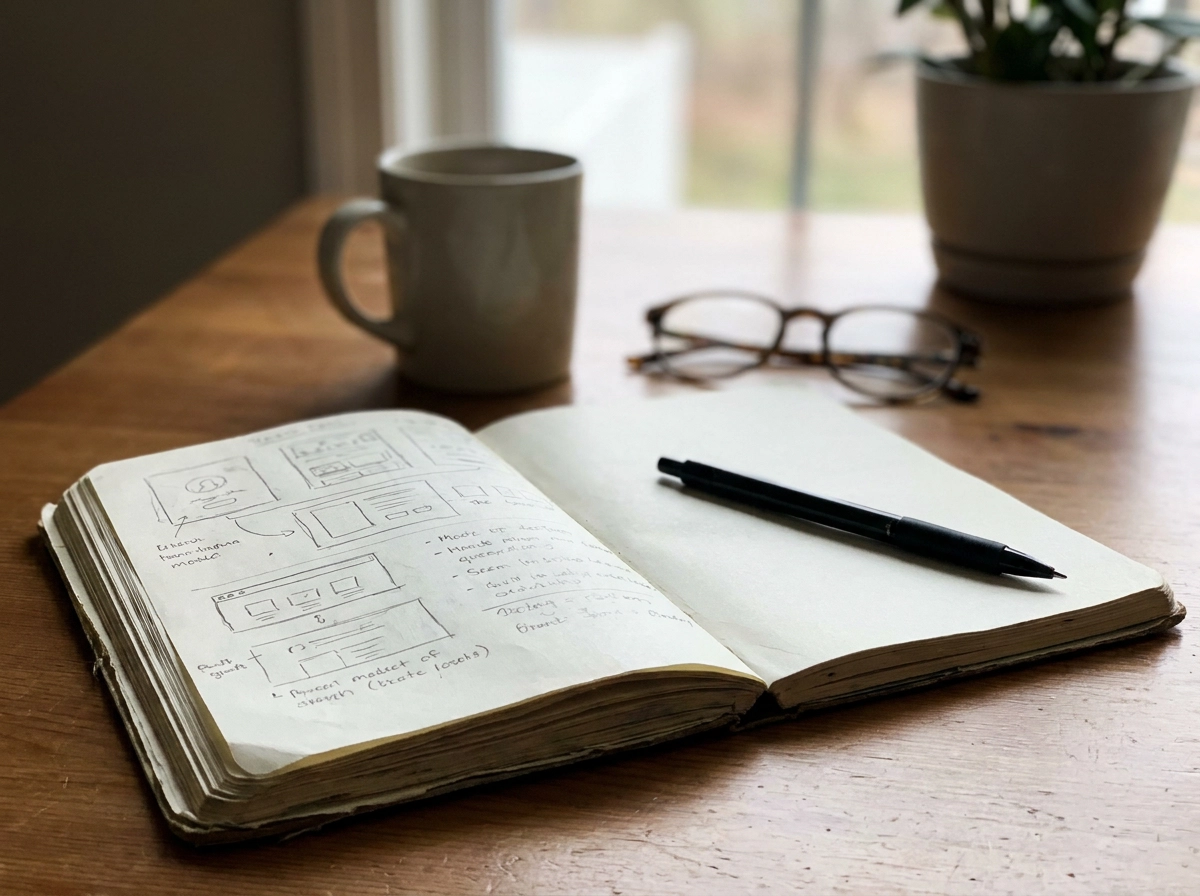
Research is the discipline that precedes every other stage, before a single wireframe gets sketched.
UX research insights and findings confirm what experienced designers already know: skipping research does not save time, it just relocates the problem. You end up building the wrong thing beautifully, then fixing it expensively.
The methods vary depending on what is already known. User interviews and usability testing when you need to understand behaviour directly. Competitive audits and analytics review when data already exists but nobody has interrogated it properly. The research approach follows the knowledge gap, not a fixed template.
In a senior freelance engagement, research often means pushing back on the brief itself. Not to be awkward, but because most original scopes are built on internal assumptions rather than user evidence. The NN/g UX Research Cheat Sheet puts it plainly: good research keeps development “in agreement with true user needs and not imaginary ones.” Imaginary ones are surprisingly common.
The goal is tight feedback loops, not a single research dump at kickoff followed by silence. The user’s perspective needs to stay in the room throughout.
In regulated sectors like financial services, this matters even more. Research surfaces trust signals and compliance risks early, while they are still cheap to address, rather than late, when they are not.
Interaction Design: How It Works, Not Just How It Looks
Once you know what users need, the next question is: how do they actually get there?
Interaction design is the practice of defining how a user moves through a product: flows, states, transitions, error handling, the logic that connects every screen. It is the skeleton underneath the surface.
And it is entirely separate from visual design. A flow can be logically airtight and look like a rough sketch. A product can look stunning and be completely baffling to use. Both are real outcomes. Neither is rare.
The best interaction design is invisible. When it works, users just move through the product. When it fails, they stop, backtrack, or give up, and they absolutely notice that. Good UX/UI design process accounts for this from the start, not as an afterthought.
This is where interface-only delivery can quietly fall short. A UI/UX designer focused on producing polished screens may never map the underlying flows at all. The screens look great in a handoff document. The gaps appear in development, or worse, in testing with real users.
Restructuring flows after development has started is significantly more expensive than resolving them at the strategy stage. This work belongs at the strategy stage, not the finish line.

Visual Design: Yes, This Part Matters Too
Visual design is where UI actually lives: typography, colour, layout, component design, the overall aesthetic that signals what kind of product this is before a user reads a single word. It matters, but it is the last layer to be applied, not the first. Doing it before research and interaction design are settled is how you end up with something that looks polished and functions poorly.
For anyone in financial services or professional services, this is not a minor point. Users form trust judgements about interfaces rapidly, and an inconsistent or unfinished interface undermines credibility regardless of how well the underlying logic works. People have abandoned transactions simply because a payment page looked slightly off. Visual design is a trust signal, full stop.
A designer who comes from brand and graphic design, rather than pure digital, brings a broader visual vocabulary to that challenge. That cross-disciplinary grounding is especially useful when a product needs to hold up across multiple touchpoints. You can see that thinking in brand-level design work where visual consistency has to carry weight across contexts.
Design systems and component libraries live here too: reusable, documented building blocks that keep a product visually consistent at scale and make the developer handoff significantly faster.
Design Process: The Invisible Skill Buyers Rarely Brief For
So far we have covered what gets designed. Process is how it gets designed, and it is the part buyers almost never ask about.
A strong design process draws on established frameworks. The Double Diamond, developed by the UK Design Council, maps the work into two phases: defining the right problem, then delivering the right solution. Other structured approaches to design and facilitation follow similar logic, diverging to explore, then converging to decide. Alongside these frameworks sit documentation practices that keep stakeholders aligned and decisions traceable, so nobody is guessing what was agreed three weeks ago.
Accessibility belongs here too. Not as a final checklist, but as a consideration baked into decisions at every stage of the project. That is a meaningful difference in practice.
Here is the thing about process: it is what lets a senior designer take an ambiguous brief, scope it accurately, and flag risks before they quietly become expensive blockers. A strong process is what makes an ambiguous brief workable, and it is worth asking any designer you consider hiring how they approach it.
Most buyers focus procurement conversations on portfolio. Understandable, but the work shown tells you what someone has made. It does not tell you whether the engagement will be well-run or chaotic.
Asking “how do you work?” is just as important as asking “what have you made?” The answer is where the real differentiator lives.
Product Strategy: Where Design Meets Business Outcomes
Process tells you how the work gets done. Strategy tells you whether the right work is getting done at all.
This is the competency that most cleanly separates a product designer from a UI/UX designer. It is not about aesthetics or flows; it is about shaping what gets built and why. That requires commercial fluency alongside design fluency, which not every designer brings to the table.
At senior level, a product designer sits in roadmap conversations and contributes evidence, not just opinions. Research findings become inputs to prioritisation decisions. If a proposed feature undermines the user experience without a clear business case, a good product designer says so. That is not overstepping; that is the job.
That shift, from delivering screens to owning outcomes, is what distinguishes a product design partner from a production resource. That mix of strategic thinking, commercial awareness, and design craft is what makes the difference between a freelance engagement that delivers a brief and one that improves it.
For founders or heads of product, this distinction is worth understanding before you commission anything. A contractor executes your brief. A product design partner interrogates it, which usually means you get to a better outcome faster and with fewer expensive surprises along the way.
Outputs vs Outcomes: The Accountability Argument
That distinction between outputs and outcomes is where product strategy stops being theoretical and starts costing (or saving) real money.
An output is a deliverable: wireframes, a prototype, a component library. An outcome is what actually changes: conversion goes up, support tickets drop, users stop abandoning the onboarding flow halfway through. One is a thing you hand over. The other is a result you helped create.
Most UI-only engagements are scoped to outputs, which is fine when that is genuinely what you need. The problem is that most buyers actually need outcomes but brief for outputs out of habit. “We need five screens designed” is an output brief. “We want users to complete onboarding without dropping off” is an outcome brief, and it is a completely different conversation.
That accountability extends beyond handoff into testing and iteration. That accountability in practice means being present through testing and iteration, not just handing over files.
This is also why research and strategy skills matter so much. You cannot be responsible for a result you did not help define. If you were not in the room when the problem was shaped, you cannot own what the solution produces.
What This Looks Like in Practice
So what does all of this actually look like when an engagement kicks off?
It starts with discovery. Before any design work begins, a good product designer needs to understand the business context, what user data already exists, and what constraints are actually in play. Nielsen Norman Group are pretty emphatic on this: skipping discovery is how teams end up solving the wrong problem with impressive craft.
Early in the engagement, stakeholders get aligned, scope gets defined, and success criteria are agreed. That groundwork is what prevents the scope creep and late-stage pivots that quietly inflate project costs. It is not glamorous work, but it earns its keep every time.
With 15-plus years across financial services, brand, and web, Simon brings the full product design toolkit to freelance engagements, including the strategic and research layers that most buyers do not think to ask for, because they did not know they were available.
Projects get structured around what needs to be true at the end, outcomes, not just deliverables, which typically sharpens the brief before any screen gets designed.
Which is, honestly, why this post exists. Buyers who arrive understanding the full scope of the role ask sharper questions, write better briefs, and get considerably more from the engagement.
Key Takeaways
If there is one thing worth carrying away from all of this, it is that digital product design is not a fancier name for UI work. As introduced above, it spans the five competency areas covered in this post, and UI is one slice of one of them.
That terminology gap produces real project consequences, which is why naming it early matters.
The clearest line between a UI delivery job and a product design engagement is accountability. UI work is scoped to outputs. Product design is accountable for outcomes, so brief for what needs to change, not just what needs to be made.
Not sure exactly what you need? That is completely normal, and it is not a reason to delay. Start with a discovery conversation rather than a deliverables list. The brief will get sharper from there.
Finally, a senior freelance product designer brings research and strategic thinking alongside the visual craft. If those layers are missing from your current brief, they probably belong in it.
